



The 30-Second Solution
The Golden Law of Restaurant Splits: Never default to a flat equal split when appetites, dietary preferences, and drink orders differ. Instead, group bill items into individual mains, shared center dishes, and distribute tax and service charges proportionally to each diner's subtotal. This prevents non-drinkers and light eaters from unfairly subsidizing expensive orders.
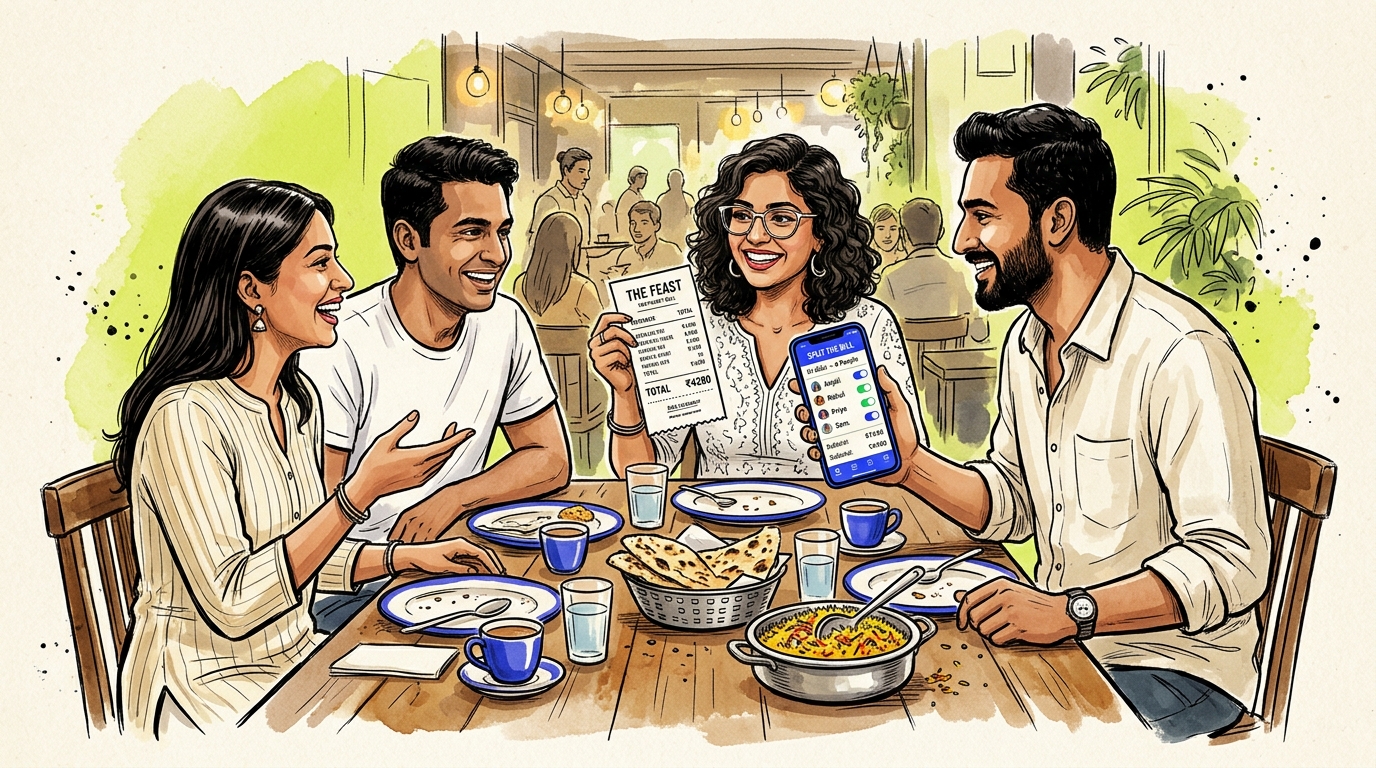
We’ve all lived this scenario: Four friends sit down for a celebratory dinner or a casual weekend hangout. The conversation flows effortlessly, laughter fills the table, and the food is great.
Then, the server drops the folio onto the table.
Inside is a bill for PKR 12,800. Ali ordered an expensive mutton karahi and a special dessert. Bilal only had a lentil daal and plain naan because he was on a tight budget. Zain and Danial shared a large platter of wings and multiple mocktails. As someone reaches for their card and suggests, “Let’s just split it four ways, PKR 3,200 each,” Bilal quietly nods while feeling a sting of financial unfairness.
Why "Divide by Number of Heads" Damages Friendships
An equal split feels fast, but it penalizes considerate eaters. Over time, recurring group dinners where costs are divided naively create silent social friction:
- The Budget Trap: Friends managing strict savings or student budgets are forced to decline social invitations because they cannot afford subsidizing others' expensive choices.
- The Non-Drinker Burden: Diners who only drink water or chai end up paying for premium coffees, specialty milkshakes, or mocktails they never touched.
- The End-of-Night Math Stall: Passing around a grease-stained receipt and calculating percentages using a calculator app drains all the warmth from the evening.
The Fair Dining Framework: Individual + Shared + Proportional Tax
To split any restaurant bill cleanly without awkwardness, separate the receipt into three mathematical layers:
1. Individual Mains
Every person takes full responsibility for their personal entree and individual beverage. If you ordered a PKR 2,800 karahi, that belongs to your share alone.
2. Shared Starters & Breads (Participant Selection)
Center dishes—such as garlic naans, salad platters, and shared appetizers—are split equally only among the friends who actually ate from them. In Yaara, you simply tag which friends participated in that specific item.
3. Proportional Tax & Service Charge (The Right Math)
This is where most phone apps and manual math fail. Sales tax and service fees should not be split equally. If your food accounted for 40% of the food subtotal, you should pay 40% of the tax and service fee. Yaara does this weighted distribution automatically.
The Worked Example: PKR 12,800 Real Restaurant Bill
Here is how a real dinner bill breaks down mathematically under Yaara’s itemized proportional engine versus an unfair 4-way split:
| Diner | Items Ordered | Subtotal | Proportional Tax (15%) | Fair Total | Unfair 50/50 Split |
|---|---|---|---|---|---|
| Ali | Mutton Karahi + Special Dessert | PKR 4,200 | PKR 630 | PKR 4,830 | PKR 3,200 (-PKR 1,630) |
| Bilal | Daal Mash + Roti + Mint Lemonade | PKR 1,400 | PKR 210 | PKR 1,610 | PKR 3,200 (+PKR 1,590 OVERPAY) |
| Zain | Chicken Biryani + Half Starter Platter | PKR 2,800 | PKR 420 | PKR 3,220 | PKR 3,200 (Equal) |
| Danial | Beef Burger + Half Starter Platter | PKR 2,730 | PKR 410 | PKR 3,140 | PKR 3,200 (+PKR 60) |
| Total Bill | Complete Table Receipt | PKR 11,130 | PKR 1,670 | PKR 12,800 | PKR 12,800 |
The Financial Reality: Under a lazy equal split, Bilal would have paid PKR 1,590 extra—literally paying double the cost of his actual meal to subsidize Ali's feast! With item-based proportional splitting, every diner pays exactly what they enjoyed.
Split the receipt, not the friendship.
Yaara’s AI receipt scanner automatically reads dishes, handles discounts, and calculates proportional taxes in 3 seconds. 100% Free on Android.
How Yaara Automates Restaurant Splits in 3 Seconds
Inside the Yaara mobile application, solving this dilemma takes zero mental arithmetic:
- Snap the Receipt: Take a photo of the restaurant bill directly in the app. Yaara’s offline-first AI receipt scanner parses every line item, tax rate, and service charge automatically.
- Tap Diners per Dish: Simply tap a friend's avatar to assign them to an item. Shared naans or wings? Tap all four. Individual steaks? Tap just one person.
- Automatic Weighted Distribution: The app's `itemSplit` algorithm automatically balances discounts, promotional voucher codes, and local sales tax with penny-perfect mathematical precision.
- One Person Pays, Group Syncs: The friend who paid gets credited on the shared ledger immediately. Friends can settle in seconds via bank transfer, cash, or leave a running balance for their next coffee run.
Frequently Asked Questions
How should tax and service charges be split on a restaurant bill?
Never divide tax and tip equally when individual orders vary widely. Tax and service charges should be distributed proportionally based on each person's subtotal share of the meal. This ensures the person who ordered a light salad doesn't subsidize the tax on an expensive steak.
What is the best way to split a restaurant bill when one friend doesn't drink or eat meat?
Use an itemized split with participant exclusion. Assign individual dishes directly to the people who ate them, and split shared appetizers only among those who participated. Apps like Yaara allow you to exclude non-participants with a single toggle.
How do you handle one person paying the whole restaurant bill upfront?
Record the full paid amount under the cardholder's name, assign the exact item shares to each friend, and attach a photo of the receipt to the expense. Friends can reimburse their exact balance over bank transfer or cash without mental math.